




The Provider Trap: How Climate Change, the Cost of Living, and Gender-Based Violence Connect in Lesotho
Posté le : 27 octobre 2026 (Blog)
This blog post is part of CIWA’s Male Champions for Women’s Empowerment blog series.
In Lesotho and across sub-Saharan Africa, a man is often defined by one question—Can you provide for your family?
From childhood, we are taught that our value as men is measured by our ability to put food on the table, pay school fees, and keep the house warm in winter. It is a heavy crown to wear. When climate change and economic shocks take that ability away, many men break, and sadly, it is women and children who bear the bruises.
As a man working in water, agriculture, and sustainable energy and as a member of CIWA’s Male Champions for Women’s Empowerment initiative, I have come to see a direct line connecting climate change, the cost of living, and gender-based violence (GBV) in our homes. We cannot talk about climate justice without talking about the pressures on men and what that does to women.
The provider trap and GBV when jobs are lost
In the last few years, people in Lesotho have been losing their jobs in factories, diamond mines, and agriculture, driven by erratic weather caused by climate change and a decline in diamond sales overseas. When a man loses his job, he doesn’t just lose income. In our culture, he loses his identity and respect.
I have participated in community dialogues where men whisper,"I am failing as a man.” That shame often turns into stress, alcohol abuse, and silence. Too often, it also ends up in sports betting, where more financial losses and anger are directed at the closest person—his partner. Civil society organizations have documented that income loss and financial shortfalls have become one of the leading triggers of intimate partner violence in Southern Africa.
The patriarchal expectation that men must be the sole provider at home is toxic for everyone. It puts impossible pressure on men and denies women their economic agency. If we want to end GBV, we as men must redefine what it means to be a man.
Providing must not be just about money. It must include providing care, respect, emotional support, and partnership with wives and partners. We need to train men to manage the pressures on them differently—to seek help, to join savings groups, and to accept that a household where both partners provide is stronger. In my family, for example, I helped my wife start a small business, which improved our financial situation, and I share household chores with her.
In my work, I now advocate for including psychosocial support and GBV prevention in climate and livelihoods projects that target men.
The high cost of farming in a changing climate
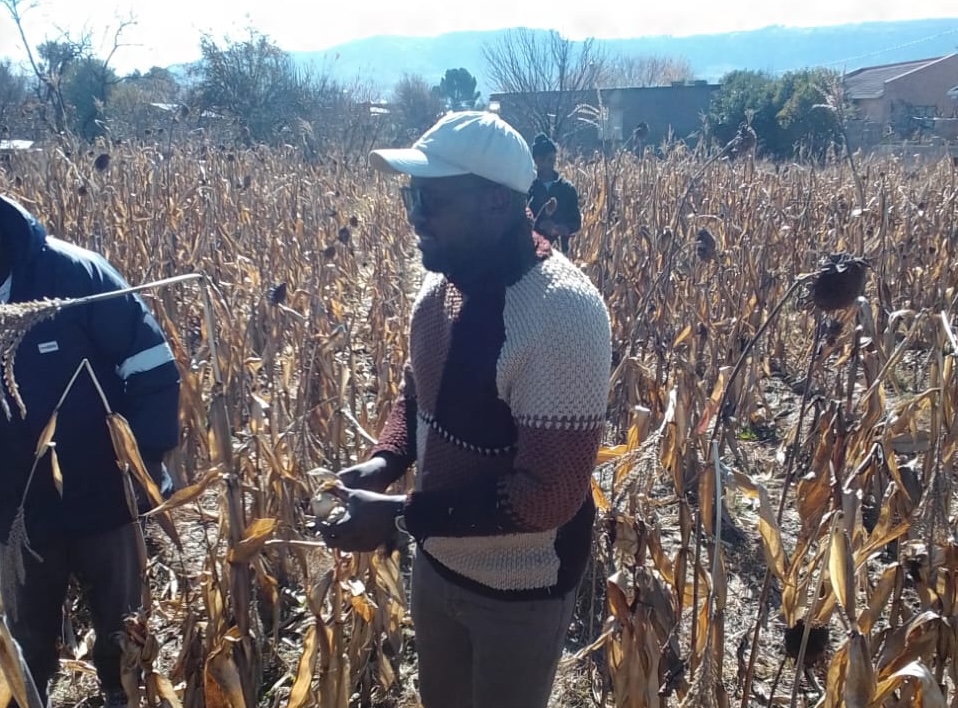
Lesotho is a farming country, but farming has changed dramatically. Because of climate change, rainfall comes too late or is too heavy, causing flooding; frost and snow are more frequent and intense; and droughts wipe out harvests.
We tell farmers to adopt climate-smart agriculture: drought-resistant seeds, drip irrigation, and conservation agriculture. These are excellent solutions, but for smallholder farmers, especially in rural areas, they are very expensive. A bag of climate-resilient seeds costs more than regular seeds. Drip irrigation kits, water tanks, shade nets, and plastic tunnels are beyond the reach of most families. Agricultural extension services, which provide farmers with information, training, and technical advice to help improve productivity and manage risks, are overstretched.
So, what happens? Men migrate to look for temporary or informal work known as piece jobs, leaving women to manage degraded land with no climate-smart inputs such as climate-resilient seeds or drip irrigation kits to improve grain production. Whenfamilies continue with low-yield practices, they sink deeper into debt and hunger. This creates a vicious cycle—food insecurity increases financial stress at home, which again fuels conflict and GBV. Meanwhile, women, who are the majority of farmers, are denied access to the finance and land they need to invest in climate-smart technologies.
As Male Champions, our role is to advocate for subsidies and accessible climate finance that reach women and youth farmers. In my community work, I have seen that when men and women co-manage agri-businesses or share the cost of farming, yields double and conflict reduces. Climate-smart agriculture must be gender-smart and affordable.
The winter no one can afford-energy for heating
In winters in Lesotho, the cold bites to the bone. Temperatures drop well below 10°C, and extreme weather events are making winters harsher and longer. To survive, families need energy for space heating and cooking.
But clean energy is expensive. A bag of coal, a gas heater, or even electricity for heaters is a luxury. Paraffin prices have risen. Many families resort to unsafe biomass, burning shrubs and dung in poorly ventilated houses. The result is respiratory illness for women and children, who stay indoors after walking long distances in search of firewood, shrubs, and dung—along with their long walks to fetch clean water for their families.
Again, the pressure falls on men to pay for this energy, and when they cannot afford it, tensions rise. I have seen families where an argument over buying a bag of coal ends in violence. Energy is a GBV issue.
The solution is not simply more energy, but rather affordable, clean energy for heating. Lesotho has huge potential for improved insulated housing, solar thermal heating, and energy-efficient stoves. As a sustainable energy professional, I advocate for social tariffs and winter energy support grants targeted at female-headed households and for men to be trained in clean cooking and heating, rather than seeing it as “women’s work.”
Striving for change
Climate change is raising the cost of living—the cost of food, water, and warmth—and the financial and emotional toll of fulfilling traditional male roles. We, as men, cannot continue to suffer in silence and make our families suffer with us. We must break the provider trap. We must share power and work at home, demand affordable climate solutions, and hold each other accountable to end violence.
Being a Male Champion is not about being perfect. It is about being present and striving for change—present in the kitchen, present in the garden, and present in the fight for gender equality and social inclusion.
If we change how we provide, we can change how we survive and adapt to climate change together.
Mokhothu Moerane is a water treatment plant operator, sustainable energy specialist, and Male Champion for gender equality in Lesotho. He is also Senior Project Coordinator at the 24+ Supportive Brothers’ Cooperative Society, where he secures and leads grant-funded projects and raises awareness of gender-based violence among the cooperative’s members.