


Dr.Fafatou Fofana: Hydrologist and advocate for data tools for regional cooperation
Posted in : Blog on 10 March 2026
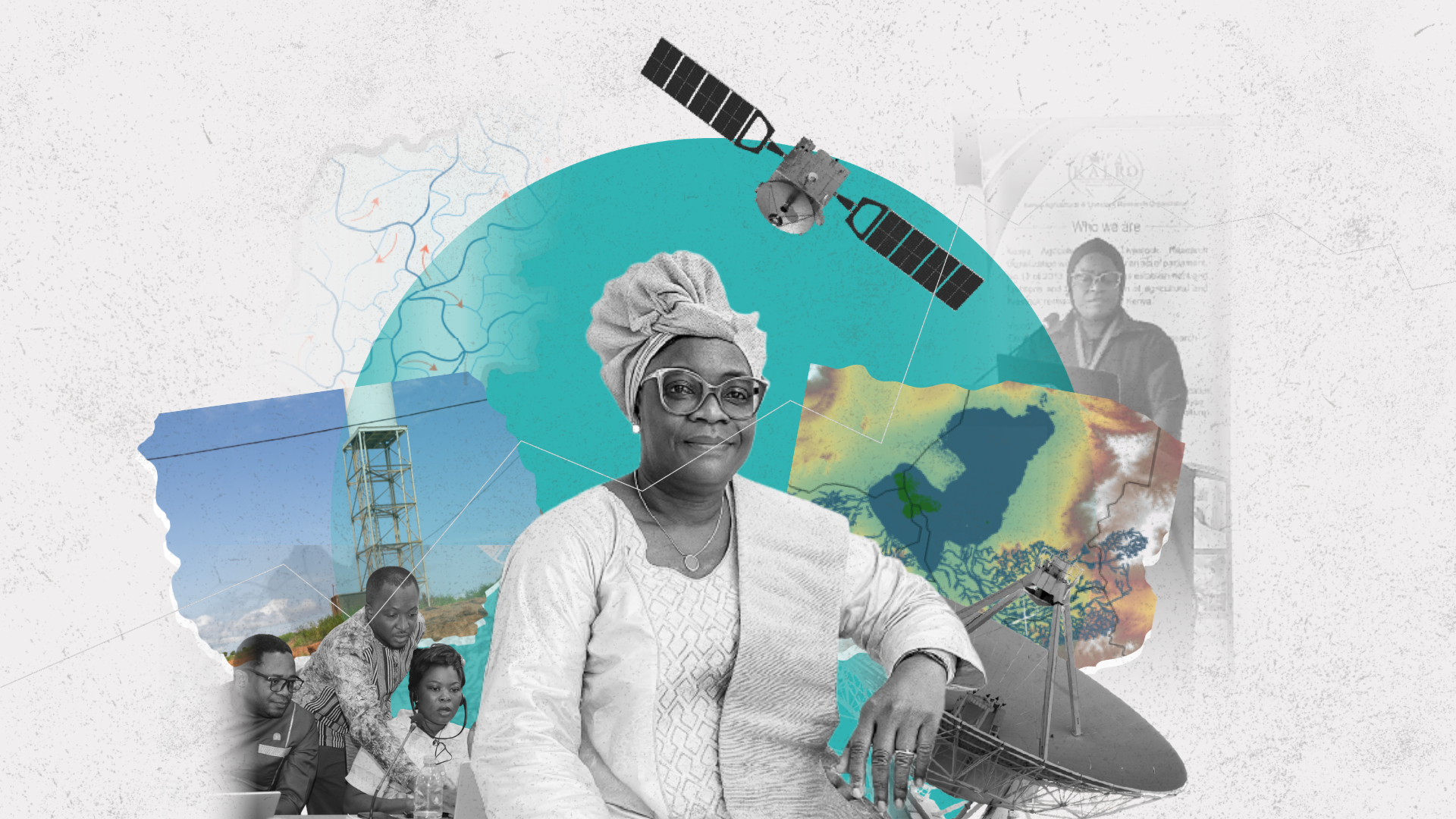
Initially trained as a rural equipment engineer specializing in hydraulics, Dr. Rafatou Fofana began her career supplying rural areas with drinking water from modern wells and boreholes equipped with human-powered pumps and constructing small water networks for six communes in the Mono department in southern Benin. “I was providing clean water to households while realizing that people also needed water for irrigation and small-scale agriculture for their survival,” says Dr. Fofana, now a hydrologist and Acting Director of the Observatory of Water Resources and Associated Ecosystems at the Volta Basin Authority (VBA).
“It’s about water for humans, water for animals, and water for crops,” she says, along with cooperation between countries that share these water resources. “Shared resources require joint solutions for sustainable development.”
Dr. Fofana was attracted to a career in water resources management not only to help communities but also because of her astrological connection; her zodiac sign is Pisces, one of the water signs.
“I liked reading horoscopes, and Pisces is all about water,” she explains. “A Pisces is more alive in the water, so I explored opportunities that could take me into this fi eld.”
Born in southern Togo and raised in Benin, Dr. Fofana, 53, obtained a master’s degree in Water and Environmental Sciences from the École des Ingénieurs de l’Équipement Rural in Burkina Faso and her PhD in Hydrology and Integrated Water Resources Management from the UNESCO Chair of Mathematical Physics and Applications, in collaboration with the Laboratory of Applied Hydrology of the University of Cotonou in Benin. Her research focused on quantitative analysis of the impact of climate change on water resources in Parakou, capital of the Borgou department and the third-largest city in Benin.
She also conducted qualitative studies to address public concerns about the risks of pollution in the city’s main water resource. Dr. Fofana’s career has not been without its challenges, including pay discrimination and sexual harassment. And, while she believes that parents are increasingly understanding “the importance of providing equal educational opportunities for girls and boys,” she also says that more women should be encouraged to enter water professions in both the private and public sectors, although some progress has been made in recent years.
The need for data sharing tools for regional trust and collaboration
Dr. Fofana has worked for a decade at the Volta Basin Authority headquarters in Ouagadougou, Burkina Faso, where she promotes the coordination and integrated management of shared water resources among the basin’s six countries. The projects she oversees focus on ensuring the sustainable use of water resources and preserving and rehabilitating ecosystems.
To this end, the Observatory collects and analyzes countries’ hydrometeorological data from Volta Basin monitoring networks. However, she says data processing suffers from a lack of technical staff, including the absence of an expert in GIS and remote sensing. She also notes that the framework for data sharing between countries is insufficient, but initiatives to address this are underway.
Dr. Fofana says that some monitoring stations are installed in areas of insecurity and vandalism, making data collection difficult and fueling “a strong interest in using satellite data.” While there has been progress in this area, she says, country partners need capacity building in processing satellite data to enable the VBA to make optimal use of available satellite products at different spatial and temporal resolutions.
Dr. Fofana participated in a CIWA training on the Water Accounting (WA) tool in 2024, as the VBA was one of three River Basin Oorganisations to pilot the development of Water Accounting Dashboards—innovative, demand-driven tools using public domain data and scalable remote sensing technologies. WA Dashboards enable transparent and standardized assessments of water use and availability at different geographic scales—fundamental to sustainable transboundary water management. Built on the WA+ methodology developed by the IWMI, the dashboards are fed entirely by public data derived from satellites. This ensures open access, reduces costs, promotes transparency and trust, and “would facilitate checking the impacts of any activity or project on water resources by riparian countries if staff from national technical directorates were directly involved in its development,” Dr. Fofana says.
The WA+ tool will enable the VBA to conduct preliminary technical assessments of countries’ project proposals based on satellite imagery. “That’s how we can determine whether a project will promote regional cooperation and integration—or risk triggering new conflicts over water use,” she says.
After the CIWA training, Dr. Fofana assembled a community of practice to conduct additional online training sessions as the tool evolves. “We will help improve it for the benefit of all,” she says.
“Our water resource is vulnerable and if we don’t work together to reduce its vulnerability, we will all lose,” says Dr. Fofana.
“Relations between upstream and downstream countries are often a source of tension and conflict,” she says. “With increasing pressures in our region, every country is striving to achieve water security, food security, and energy independence. We have shared resources, and we need common solutions. It’s all about solutions.”