





Pinimidzai Sithole: A Male Champion who preaches and practices gender equality
Posted in : Blog on 31 March 2026
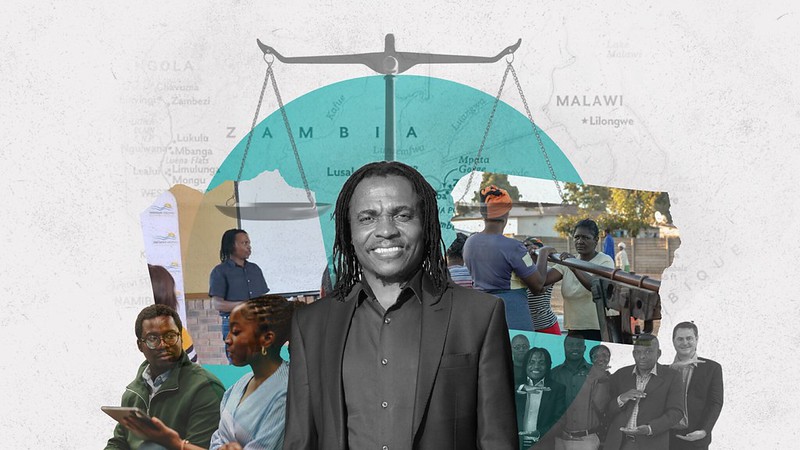
Pinimidzai Sithole, known as Pinnie, had an “aha” moment about gender equality as an undergraduate sociology student at the University of Zimbabwe.
Taking a course on gender and development in the late 1990s from renowned Zimbabwean feminist and sociologist Rudo Gaidzanwa, Sithole says he realized that patriarchal attitudes were ubiquitous during his childhood in the rural eastern highlands of Zimbabwe.
“I grew up accepting as normal that it’s your sisters who are responsible for cooking for you, for fetching water for you, for gathering firewood for you,” he says. “As a boy, your only responsibility was looking after the livestock. And you are socialized to think about STEM (science, technology, engineering, and mathematics) professions, while your sisters are nudged to be nurses and teachers.”
“I realized that we should have fairly distributed the tasks whether you are a boy or a girl,” says Sithole, 49. “After that class, I started challenging the pervasive patriarchy and calling myself a feminist ally. Since then, I have been preaching and practicing it.”
It’s no surprise, then, that Sithole gravitated toward gender issues during his career or that he joined CIWA’s Male Champions for Women’s Empowerment initiative in 2024—or that he and his wife are raising their two children in Pretoria with more progressive gender norms.
An accidental career in the water sector
It was pure serendipity that Sithole, who received his master’s degree in sociology and social anthropology, ended up working on water issues. Because of his strong research skills, Sithole was introduced to an American professor at the University of Zimbabwe’s Center for Applied Social Sciences who was deeply involved in water sector reforms in Zimbabwe.
Before long, Sithole found himself immersed in the professor’s work as a research assistant. “That’s when I started this keen interest in the water sector,” he says.
He never looked back.
It was also by chance that Sithole ended up working in South Africa. Presenting a paper on human rights and water at an international conference in Johannesburg, Sithole was approached by a staffer at the South African office of the International Water Management Institute (IWMI). He began working there as a graduate research assistant while also pursuing his PhD in Public Administration with a focus on water governance from the University of the Western Cape.
Today, Sithole is a Governance and Social Specialist at the Global Water Partnership Southern Africa (GWPSA), where he focuses on equality, women’s economic empowerment, and social development and inclusion. As a gender specialist, he works to ensure that GESI is integrated into projects executed by the GWPSA across transboundary basins shared by riparian Member States in the SADC region. He conducts gender and socioeconomic analyses and stakeholder mapping and prioritization. He also does gap analyses for governance and institutional arrangements and works with stakeholders who have been disadvantaged—including women, poor men, and people with disabilities—to build their technical and social capacity to work together effectively and increase the likelihood that institutions will consider them for decision-making positions.
Fighting gender barriers with support from the Male Champions for Women’s Empowerment (MCWE)
Sithole is keenly aware of how women are excluded from decision-making spaces because of gender norms.
“Let’s say you are a woman who is a manager at a catchment agency who speaks up at a forum attended mostly by men,” he says. First, her voice and views aren’t respected: “She doesn’t receive equal recognition. When a man repeats the same point, you hear clapping.”
This is compounded when the men gather later at a bar to discuss issues and make decisions. Social norms preclude her from joining men there, thus effectively excluding her from decision making. “It prejudices women who can’t be in those places,” he says.
Sithole said that MCWE training conducted by CIWA’s Gender and Social Inclusion specialist “has equipped me with better tools on how to handle these situations.” He realized that he was being “too confrontational” and becoming frustrated with the men he wanted to educate, “which could create massive pushback and direct vitriol toward the woman” he was trying to support.
Now, he says, “I take them aside and say, ‘it is an expectation of your government’s gender policy and the donors who are supporting your project that we treat all participants equally and fairly.’ They know that partner support is crucial and following government policy mandates is an expectation. That is the leverage I use. . . . And, in some instances, I might ask the male aggressor if he is willing to apologize to the woman and assure her that he will do better.”
He also asks the women: “How can we best support you so that you don’t fear expressing your views? We are here for you. Your voice matters.”
“The work that the Male Champions are doing is pivotal,” Sithole says. “Having Male Champions reach out to other men and create awareness and a sense of urgency has been very powerful. I tell them, would we want these barriers to affect our daughters, to affect our mothers, to affect our sisters? When we personalize it like that, other men can see why it is important to join the MCWE. Then we can rally together for a greater cause.”