


CIWA: Unlocking Africa’s Water Potential
Transforming Challenges into Opportunities
The Cooperation in International Waters in Africa (CIWA) is at the forefront of tackling Sub-Saharan Africa’s most pressing water-related challenges and transforming them into opportunities for resilience and growth:
- Escalating water insecurity
- Devastating climate change impacts
- Rapid biodiversity loss
- Cross-border tensions
With 90 percent of Africa’s surface water spanning 63 transboundary river basins across 48 countries, cooperation is not just beneficial—it is essential. And cooperation is in CIWA’s DNA.
A Unique Force for Collaboration
Since 2011, CIWA has been catalyzing positive change by accelerating transboundary water management and development in Africa:
- The only continent-wide program solely dedicated to this critical mission
- A key player in realizing the World Bank’s vision for a sustainable, resilient, and inclusive Africa
- Proven track record of inspiring countries to work together for mutual benefit
Our Impact: Beyond Borders, Beyond Water
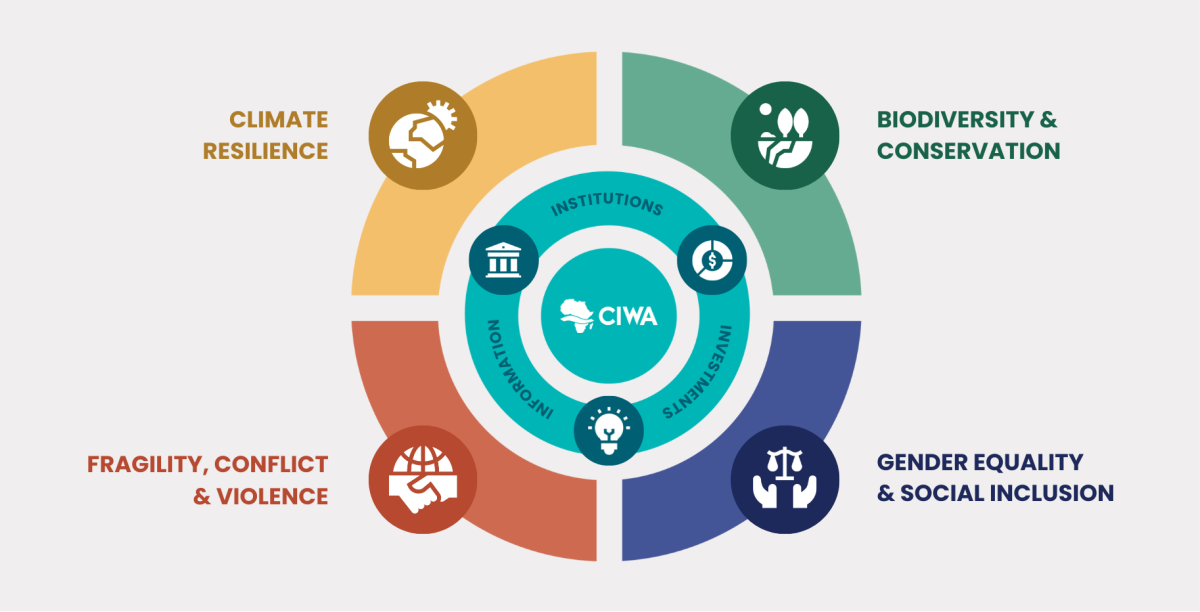
CIWA consistently achieves results by promoting its three pillars:
- Information—Developing and sharing crucial information and data on water resources
- Institutions—Building capacity for effective transboundary water management
- Investments—Catalyzing projects that enhance water security
In CIWA 2.0’s new Theory of Change, Fragility Conflict and Violence (FCV), Gender Equality and Social Inclusion (GESI), Biodiversity and Conservation, and Climate Resilience are the pathways to achieving impact on the three Is.
A Regional Approach to Water Security
Sub-Saharan Africa faces dual challenges of water scarcity from drought and excess water from floods along with other shocks. CIWA tailors its approach to each region’s unique needs:
West & Central Africa
Addressing high inequality, fragility, and climate disasters by:
- Filling knowledge and capacity gaps
- Improving water resources management
- Promoting gender equality
Southern Africa
Tackling food and water insecurity, poverty, and economic fragility by:
- Implementing cross-border drought risk management
- Sustainably managing transboundary groundwater
East Africa
Enhancing resilience to climate change and water insecurity by:
- Advancing water-related disaster mitigation
- Developing early-warning systems for floods and droughts
- Supporting riparian dialogue
Horn of Africa
Improving fragility, resilience, and water security by:
- Strengthening access to groundwater resources
- Addressing knowledge and capacity gaps
- Identifying strategic investments and policy actions
Cross-Cutting Strategies for Lasting Impact
CIWA’s approach to water resources management includes:
Climate Resilience: Supporting data-driven decision making for climate shocks and transboundary cooperation
Fragility, Conflict, and Violence: Strengthening cooperative management of shared waters to ease tensions, promote stability, and build resilience
Biodiversity and Conservation: Improving groundwater management to boost water security and protect ecosystems
Gender and Social Inclusion: Promoting equal opportunities for women and vulnerable populations.
Join Us in Shaping Africa’s Future
By supporting CIWA, you are not just investing in water resources—you are also financing:
- Improved livelihoods for millions of Africans
- Enhanced regional stability and cooperation
- A more resilient, sustainable continent
Partnering with CIWA will help us turn the challenge of transboundary waters into a source of shared prosperity on a livable planet. Please join our current donors—Austria, Denmark, the European Commission, the Netherlands, Norway, Sweden, and the United Kingdom—to help create a thriving, resilient Africa.